
The Making of a COP Shirt: From Fabric to Finish
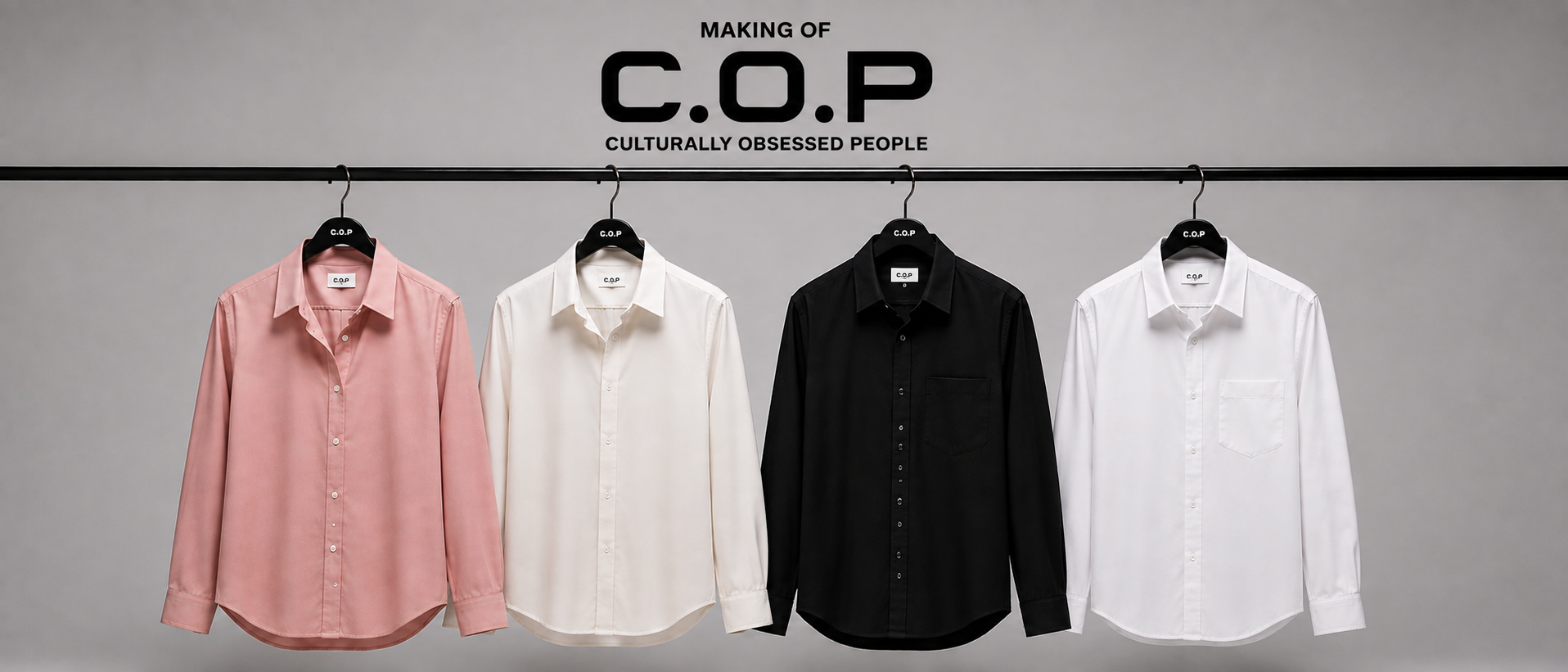
A shirt looks simple on a hanger. Fabric, collar, buttons, done. What that hanger doesn't show is everything that happened before it got there — the decisions that decide whether a shirt survives forty washes or falls apart after ten. Here's what actually goes into a COP shirt, step by step, and why we haven't found a way to shortcut any of it.
Step 1: Choosing the Fabric
Every shirt starts as a decision about fabric, long before pattern or stitching enters the picture. We work primarily with breathable cottons and premium cotton blends, chosen against a simple test: how does this hold up after real, repeated wear — not how it looks under studio lighting on day one.
This matters more than most people realise. Two shirts can look identical in a product photo and behave completely differently after a month of actual use. Thinner, lower-grade cotton pills, loses its shape at the collar, and thins out at the elbows. A well-chosen fabric resists all three. It's not a visible difference at checkout. It's a very visible one three months later.
Step 2: Pattern and Fit
Fabric decides how a shirt wears. Pattern decides how it fits — and fit is where most fast-turnaround clothing cuts corners, because refining a pattern takes iteration, not just a single sample approval. We work across three fit categories — Tailored, Classic, and Relaxed — because "one fit for everyone" rarely actually fits anyone well. A tailored fit needs a closer cut through the chest and waist without restricting movement. A relaxed fit needs enough room to feel easy without reading as shapeless. Getting each of these right means testing across body types, not just approving a single sample and scaling it up.
Step 3: Cutting and Construction
This is where handcrafted stops being a marketing word and starts being a literal description of process. Every COP garment is handcrafted in India, with cutting and construction handled by skilled tailors rather than a fully automated line. That means small, human decisions at every stage — how a seam is finished, how a collar is interfaced, how much ease is left at a shoulder seam. It's slower than a fully automated process. It's also why a handcrafted shirt tends to hold its shape at stress points — collars, cuffs, seams — long after a mass-produced equivalent has started to fray or lose structure.
Step 4: Quality Checks, By Hand
Before any COP garment ships, it goes through a hand quality check — stitching, seams, buttons, and finish reviewed individually rather than sampled in batches. This is the step that's easiest to skip when speed is the priority, and it's usually the first thing that shows up in customer complaints when it is skipped: loose threads, misaligned buttons, seams that pucker after the first wash. We treat this step as non-negotiable, not because it's the most visible part of the process, but because it's the part that decides whether the garment shows up as promised.
Why This Process Is Slower — On Purpose
None of the above is the fastest way to make a shirt. A fully automated, high-volume process could cut every one of these steps down significantly. We've made a deliberate choice not to, because the entire point of building clothing meant to last is that you can't rush the parts that determine whether it actually does. This is also why COP doesn't launch as many new styles per week as some fast-fashion competitors. Fewer styles, produced properly, is the trade-off — and it's one we think shows up the first time you reach for a COP shirt for the fortieth time, not the first.
What This Means for You, Practically
Understanding this process isn't just background information — it changes how you should actually treat and choose your clothing:
• Check the fabric weight, not just the print. A heavier, well-woven cotton will outlast a lighter one printed with the same design.
• Fit categories exist for a reason. If you've always bought "medium" regardless of brand, try checking whether Tailored, Classic, or Relaxed actually matches how you want a shirt to sit — it changes everything about how it wears.
• Cold wash, air dry. This single habit does more to preserve stitching and fabric structure than almost anything else you can do post-purchase.
A shirt that's built this way rewards a little care. It also asks for less of it over time — no early fraying, no early fading, no early replacement.
The Bottom Line
A shirt is a small thing to think this hard about. But small things, done properly, are usually what separate clothing you keep wearing from clothing you quietly stop reaching for. That's the whole idea behind how we build a COP shirt fabric first, fit second, construction and quality checks that don't get skipped, even when skipping them would be faster.